
One of the most common questions new exporters ask is, “Where do I actually get my export documents signed?” Getting your Certificate of Origin (CoO) from an unrecognized body can result in customs rejecting your shipment at the destination port.
In India, the government has strictly designated specific bodies to issue these certificates. The authority you need to approach depends entirely on the type of Certificate of Origin you are applying for.
Here is the complete guide on who issues a Certificate of Origin in India.
1. Who Issues Preferential Certificates of Origin?
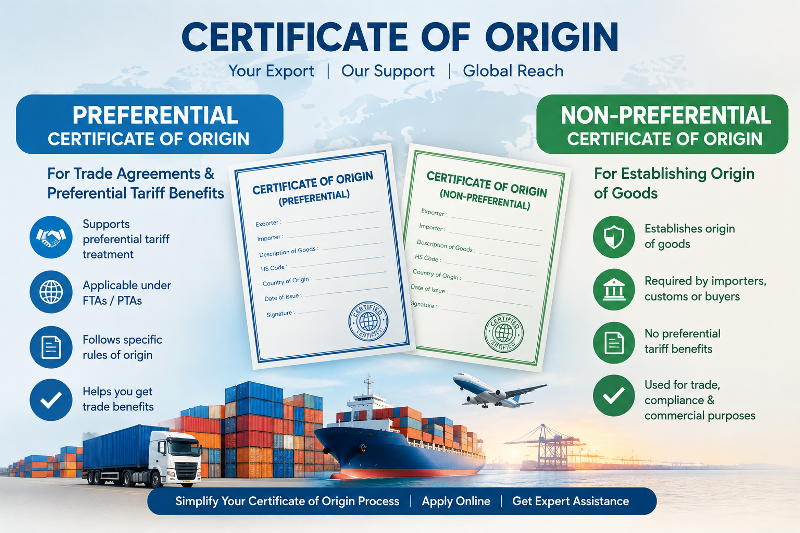
A Preferential CoO is used when exporting to countries with which India has specific trade agreements (like FTAs or GSP), allowing the buyer to claim import duty exemptions. Because this involves international tax benefits and strict origin criteria, only specific government-authorised agencies can issue them.
The primary issuing authorities include:
-
Export Inspection Agency (EIA): The most common authority for issuing preferential certificates for various manufactured and industrial goods.
-
Directorate General of Foreign Trade (DGFT): Regional authorities of the DGFT can issue certificates for specific trade agreements.
-
Marine Products Export Development Authority (MPEDA): Specifically for the export of seafood and marine products.
-
Textile Committee: For textile and garment exports.
-
Tobacco Board, Spices Board, and Coir Board: For their respective specific commodities.
2. Who Issues Non-Preferential Certificates of Origin?
A Non-Preferential CoO simply proves that the goods were made in India but does not offer any tariff exemptions. Because the compliance criteria are less strict, the government has authorized a wider network of trade bodies to issue these.
The primary issuing authorities include:
-
Federation of Indian Export Organisations (FIEO): A major body assisting exporters across India.
-
Local Chambers of Commerce: Any Chamber of Commerce or trade association explicitly recognized and enlisted by the DGFT. (e.g., PHD Chamber of Commerce, Indian Chamber of Commerce).
3. The Shift to Electronic Issuance (eCoO 2.0)
It is highly important for exporters to note that the physical, manual stamping of CoOs is becoming a thing of the past. Under the current DGFT framework, authorised agencies now process and issue CoO applications through a designated electronic platform (the eCoO 2.0 portal). You must verify the current electronic process rather than relying on outdated manual application procedures.
Export Documentation Assistance in New Delhi
If you are confused about which agency to select on the eCoO portal or how to draft your product origin declarations, we are here to help.
Please note: Y.C. Consultation provides expert business application and documentation assistance to help you navigate the electronic filing framework; we are a consulting firm, not an authorised issuing agency ourselves.
We help you prepare your paperwork perfectly so the authorised agencies approve your application without delay. Contact us today:
-
Mobile / WhatsApp: 9891065895
-
Email: indiaieccode@gmail.com
-
Website: https://ieccode.in

Pingback: Certificate of Origin Documents Required for Export in India