
When exporting goods from India, international customs authorities require specific documentation to verify where the products were manufactured. One of the most critical documents in this process is the Certificate of Origin (CoO).
However, many new and even experienced exporters often get confused between the two main types of this document: the Preferential Certificate of Origin and the Non-Preferential Certificate of Origin. Choosing the wrong one can lead to delayed shipments or missed tax benefits.
Here is a complete breakdown of the differences between Preferential and Non-Preferential CoO to help you ensure smooth export customs clearance.
1. What is a Preferential Certificate of Origin?
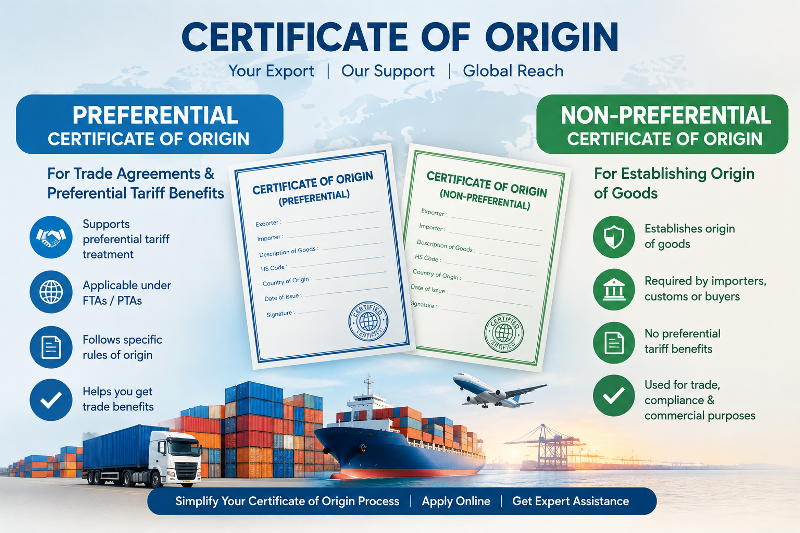
A Preferential Certificate of Origin is issued when your goods are being exported to a country that has a trade agreement with India (such as a Free Trade Agreement (FTA) or Comprehensive Economic Cooperation Agreement (CECA)).
This certificate proves that your goods qualify for tariff concessions. By presenting this document, the importer in the destination country can claim a reduced or zero import duty.
-
Primary Benefit: Lowers the landing cost of your goods for the buyer, making your products more competitive in the global market.
-
Examples of Agreements: Generalized System of Preferences (GSP), South Asian Free Trade Area (SAFTA), Asia-Pacific Trade Agreement (APTA).
-
Issuing Authorities in India: Export Inspection Agency (EIA), Directorate General of Foreign Trade (DGFT), Marine Products Export Development Authority (MPEDA), etc.
2. What is a Non-Preferential Certificate of Origin?
A Non-Preferential Certificate of Origin simply states the country of origin of the goods. It does not grant the importer any tariff exemptions or duty reductions.
Even if there is no trade agreement between India and the buyer’s country, customs authorities often still require this document to ensure the goods are legally allowed to enter and comply with local trade regulations (such as anti-dumping laws or embargoes).
-
Primary Benefit: Ensures basic customs compliance and prevents your goods from being blocked at the destination port.
-
Use Case: Required by banks for Letter of Credit (LC) negotiations and by foreign buyers for their internal import documentation.
-
Issuing Authorities in India: Local Chambers of Commerce (recognised by the government), Federation of Indian Export Organisations (FIEO).
3. Quick Comparison: Preferential vs. Non-Preferential CoO
| Feature | Preferential CoO | Non-Preferential CoO |
| Main Objective | To claim import duty concessions/exemptions. | To prove the origin of goods for basic customs clearance. |
| Tariff Benefits | Yes (Reduced or Zero Duty). | No (Standard duty applies). |
| Trade Agreements | Mandatory (requires an active FTA, CECA, GSP, etc.). | Not required. |
| Complexity | High (Requires strict value-addition and origin criteria proofs). | Low (Standard commercial invoice and packing list usually suffice). |
| Issuing Authority | Government-designated bodies (DGFT, EIA). | Chambers of Commerce, FIEO. |
4. Which One Do You Need?
The choice depends entirely on your buyer’s location and their specific request.
-
If India has an active trade agreement with the destination country, you should apply for a Preferential CoO to give your buyer a financial advantage.
-
If you are exporting to a country without a trade agreement (like the USA or standard European shipments outside specific GSP benefits), a Non-Preferential CoO is standard practice.
Need Help with Export Documentation?
Navigating export paperwork can be time-consuming. Whether you need assistance with an urgent Certificate of Origin, AD Code Registration, or your IEC Code, the team at Y.C. Consultation is here to ensure your shipments move without delay. Contact our New Delhi office today for fast turnaround times and expert export documentation support:
-
Mobile / WhatsApp: 9891065895
-
Email: indiaieccode@gmail.com
-
Website: https://ieccode.in

Pingback: How to Apply for Certificate of Origin Online in India (eCoO)