
If you export goods from India, a Certificate of Origin (CoO) can play an important role in your international trade documentation. This certificate identifies the country where your goods originate. Depending on the destination country, buyer requirements, and applicable trade agreement, you may need a Certificate of Origin before completing your export documentation.
Today, exporters can manage Certificate of Origin applications through electronic systems. In addition, the Government of India has introduced the eCoO 2.0 platform to support electronic Certificate of Origin processing.
Therefore, if you are searching for a Certificate of Origin online in India, this guide will help you understand the process, documents, types, fees, and application requirements.
What Is a Certificate of Origin?
A Certificate of Origin is a trade document that identifies the country of origin of exported goods.
For example, an Indian exporter may ship products to a buyer in another country. In that situation, the buyer or authorities in the destination country may ask for a Certificate of Origin to establish the origin of those products.
Therefore, a Certificate of Origin can support several international trade requirements, including:
- Export shipments
- Customs clearance
- International trade documentation
- Buyer requirements
- Trade agreement requirements
- Import regulations
- Establishing the origin of exported goods
However, the exact requirement can vary according to the product, destination country, trade agreement, and applicable authority.
Certificate of Origin Online in India
The Certificate of Origin application process has increasingly moved toward electronic processing. As a result, exporters can manage many application-related activities online.
The Government of India has introduced eCoO 2.0, an electronic platform for Certificate of Origin applications and related services.
Consequently, exporters can handle relevant application information and supporting documents electronically. However, online processing does not remove the need to provide accurate information and appropriate supporting documents.
Therefore, exporters should carefully check their product details, invoice information, HS Code, destination, and origin-related information before submitting an application.
Types of Certificate of Origin
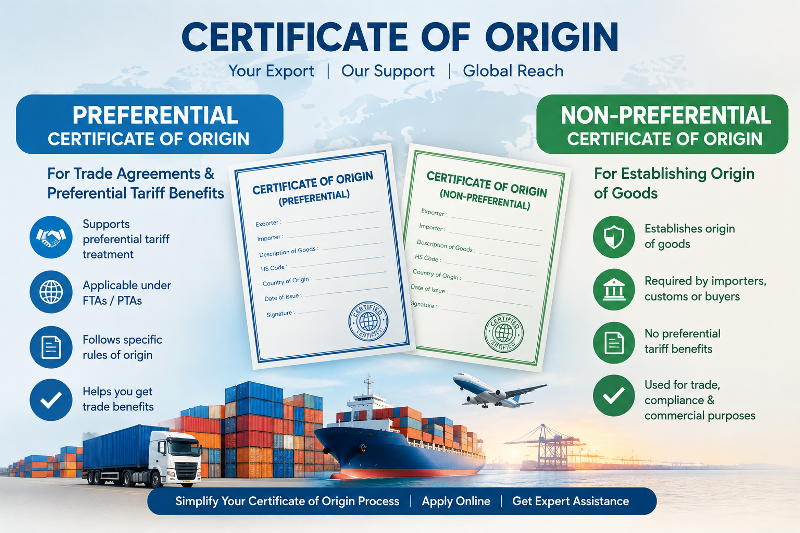
Exporters generally deal with two major categories of Certificate of Origin:
- Preferential Certificate of Origin
- Non-Preferential Certificate of Origin
Although both certificates relate to the origin of goods, they serve different purposes. Therefore, exporters should identify the correct type before starting an application.
1. Preferential Certificate of Origin
A Preferential Certificate of Origin relates to an applicable trade agreement or preferential arrangement.
In particular, an eligible exporter may use this certificate when seeking preferential tariff treatment for qualifying goods under the relevant trade agreement.
For example, an applicable Free Trade Agreement (FTA) may provide specific tariff benefits when exported goods satisfy the agreement’s rules of origin.
Therefore, exporters should first identify the relevant trade agreement. After that, they should check the applicable product-specific rules of origin.
A Preferential Certificate of Origin may involve:
- Specific rules of origin
- Product eligibility requirements
- Supporting manufacturing information
- Origin declarations
- Trade agreement requirements
- Additional documentation
However, eligibility depends on the specific agreement and product. Therefore, exporters should verify the applicable requirements before making an origin claim.
Who May Need a Preferential Certificate of Origin?
Exporters may need a Preferential Certificate of Origin when:
- The importing country provides a preferential tariff arrangement
- The shipment qualifies under an applicable trade agreement
- The buyer requests preferential origin documentation
- Customs authorities require evidence of origin for a tariff preference claim
As a result, exporters should understand the relevant trade agreement before applying.
2. Non-Preferential Certificate of Origin
A Non-Preferential Certificate of Origin establishes the origin of exported goods without claiming preferential tariff treatment under a trade agreement.
For example, a foreign buyer may request a Certificate of Origin to confirm that goods originated in India. Similarly, an importing country’s authorities may require origin documentation for customs or regulatory purposes.
Therefore, exporters may need a Non-Preferential Certificate of Origin for:
- Buyer requirements
- Customs documentation
- International trade transactions
- Regulatory requirements
- Commercial documentation
- Import-related procedures
However, the exact requirements depend on the transaction, product, destination, and applicable authority.
Preferential vs Non-Preferential Certificate of Origin
At first glance, the two certificates may look similar. However, their purpose can differ significantly.
| Feature | Preferential Certificate of Origin | Non-Preferential Certificate of Origin |
|---|---|---|
| Main purpose | Supports preferential tariff treatment where applicable | Establishes the origin of goods |
| Trade agreement | Generally linked to a preferential arrangement | Not intended to claim preferential tariff benefits |
| Rules of origin | Specific rules may apply | Applicable origin requirements apply |
| Exporters | Used by eligible exporters | Used by exporters when origin documentation is required |
| Tariff benefit | May support a qualifying preferential claim | Does not provide preferential tariff treatment |
| Application requirements | Depend on the applicable agreement | Depend on the applicable origin requirements |
Therefore, do not select a Certificate of Origin type only because a buyer asks for a “COO.” Instead, confirm which type the transaction requires.
Who Needs a Certificate of Origin?
Many businesses involved in international trade may need a Certificate of Origin.
For example, the requirement can apply to:
- Manufacturers
- Merchant exporters
- Trading companies
- Export houses
- Small and medium-sized businesses
- E-commerce exporters
- Textile exporters
- Garment exporters
- Handicraft exporters
- Engineering product exporters
- Machinery exporters
- Food product exporters
- Pharmaceutical exporters
- Chemical exporters
- Auto component exporters
However, not every exporter needs the same type of Certificate of Origin.
Therefore, you should check the requirements for your specific product and destination before starting the application.
Documents Required for Certificate of Origin
The required documents can vary according to the type of CoO and the applicable application process.
Generally, exporters may need the following information and documents:
- Importer Exporter Code (IEC)
- Exporter’s name and address
- Importer’s details
- Commercial invoice
- Packing list, where applicable
- Product description
- HS Code
- Country of destination
- Export details
- Manufacturing information
- Origin declaration
- Supporting purchase documents, where applicable
- Production or cost information, where applicable
- Other documents requested by the relevant authority
In addition, preferential applications may require additional information to demonstrate compliance with specific rules of origin.
Therefore, prepare complete and consistent documents before submission. This approach can help reduce avoidable queries and delays.
How to Apply for Certificate of Origin Online?
The application process can vary depending on the type of Certificate of Origin and the applicable system. Nevertheless, exporters can generally understand the process through the following steps.
Step 1: Identify the Required CoO Type
First, determine whether you need a Preferential Certificate of Origin or a Non-Preferential Certificate of Origin.
If you want to claim preferential tariff treatment, identify the applicable trade agreement first. Then, review its rules of origin.
Step 2: Prepare Your Export Details
Next, collect the important information related to your shipment.
This may include:
- Exporter’s details
- IEC
- Importer’s details
- Destination country
- Invoice number
- Invoice date
- Product description
- HS Code
- Quantity
- Value
- Origin information
As a result, having this information ready can make the application process easier.
Step 3: Prepare Supporting Documents
After collecting the shipment details, prepare the required supporting documents.
For example, you may need the commercial invoice, packing information, origin declarations, manufacturing information, or other supporting records.
Step 4: Complete the Online Application
Next, enter the required information in the applicable electronic Certificate of Origin system.
At this stage, check every important field carefully. In particular, compare the application information with your commercial invoice and other export documents.
Step 5: Complete Authentication Requirements
Depending on the applicable process, you may need to complete electronic signing or another authentication step.
Therefore, keep the required digital signing credentials or other authentication information ready when necessary.
Step 6: Submit the Application
After reviewing the application, submit it through the applicable electronic system.
However, do not rush this step. A small mismatch in the exporter name, invoice details, product description, or HS Code can result in a query.
Step 7: Respond to Queries, If Required
If the reviewing authority or agency requests clarification, provide the required information or documents.
Therefore, keep your supporting records available until the application process finishes.
Step 8: Obtain the Certificate
Finally, after the applicable process is completed, you can obtain the Certificate of Origin through the relevant electronic process.
What Is eCoO 2.0?
eCoO 2.0 refers to the revamped electronic Certificate of Origin platform introduced by the Government of India.
The platform supports electronic processing of Certificate of Origin applications and related services.
For exporters, electronic processing can simplify document handling and reduce the need for unnecessary physical paperwork.
In addition, the system provides features designed to support exporters and issuing agencies.
However, exporters should always check the latest official instructions before submitting an application because government procedures and system requirements can change.
Certificate of Origin Fees in India
Certificate of Origin costs can vary depending on several factors.
For example, the total cost may depend on:
- Type of Certificate of Origin
- Applicable issuing authority or agency
- Application requirements
- Number of documents
- Trade agreement involved
- Professional assistance required
Therefore, exporters should not assume that one fixed fee applies to every Certificate of Origin application.
If you use a professional service provider, remember that the professional service fee may differ from any official or issuing-agency charges.
As a result, always confirm the applicable charges before submitting your application.
Why Use Certificate of Origin Application Assistance?
Although online systems simplify the process, exporters still need to prepare accurate information and supporting documents.
For this reason, professional application assistance can be useful, especially for first-time exporters.
A service provider may help with:
- Understanding application requirements
- Preparing application information
- Checking supporting documents
- Reviewing shipment details
- Identifying missing information
- Understanding Preferential and Non-Preferential CoO requirements
- Providing submission assistance
- Following up on documentation-related queries
Moreover, professional assistance can help small businesses manage export documentation more efficiently.
However, the exporter must provide accurate and genuine information. Therefore, always review the final application before submission.
Certificate of Origin for Exporters in India
Indian exporters from different industries may encounter Certificate of Origin requirements.
For example, businesses exporting textiles, garments, engineering products, machinery, handicrafts, food products, chemicals, pharmaceuticals, and automotive components may need origin documentation depending on the transaction.
Therefore, before applying, check the following:
- Which type of Certificate of Origin do you need?
- Which country are you exporting to?
- Does a preferential trade agreement apply?
- What rules of origin apply?
- Which supporting documents are required?
- Which electronic application process applies?
By checking these points first, you can reduce confusion during the application process.
Certificate of Origin Online Service Across India
Online assistance makes Certificate of Origin services accessible to exporters across India.
For example, exporters located in:
- Delhi
- Gurgaon/Gurugram
- Noida
- Mumbai
- Ahmedabad
- Surat
- Chennai
- Bengaluru
- Hyderabad
- Kolkata
- Pune
- Jaipur
- Ludhiana
- Rajkot
- Coimbatore
can seek online assistance for their Certificate of Origin documentation, subject to the applicable issuing process.
Therefore, exporters do not necessarily need to visit a service provider physically just because they operate from another city.
Certificate of Origin Consultant in India
A Certificate of Origin consultant in India can provide application and documentation assistance to exporters.
Depending on the service, assistance may include:
- Application preparation
- Document checking
- Information verification
- Submission support
- Follow-up assistance
- Process guidance
In addition, exporters should clearly understand what the service provider includes in its professional fee.
If you are choosing a service provider, check the documentation requirements, service scope, applicable official charges, and expected process before proceeding.
Common Certificate of Origin Application Mistakes
Exporters often face avoidable issues because of documentation errors. Therefore, review your application carefully before submission.
1. Incorrect HS Code
First, check the HS Code carefully. An incorrect code can create questions about the product and applicable origin requirements.
2. Invoice and Application Mismatch
Next, compare the application with your commercial invoice.
The exporter name, invoice number, product description, quantity, and other important details should remain consistent.
3. Incorrect Exporter Details
Similarly, check the IEC, company name, address, and other business details before submitting the application.
4. Missing Supporting Documents
In addition, make sure you have all documents required for your particular application.
5. Selecting the Wrong CoO Type
Preferential and Non-Preferential Certificates serve different purposes. Therefore, confirm which type your buyer, destination country, or applicable trade arrangement requires.
6. Incorrect Origin Information
Finally, provide accurate origin information based on your actual manufacturing and sourcing records.
Frequently Asked Questions
1. What is a Certificate of Origin?
A Certificate of Origin is a trade document that identifies the country of origin of exported goods.
2. Can I apply for a Certificate of Origin online in India?
Yes. India has electronic systems for Certificate of Origin processing. However, the applicable process depends on the type of CoO and current requirements.
3. What is a Preferential Certificate of Origin?
A Preferential Certificate of Origin relates to an applicable preferential trade arrangement and can support a qualifying claim for preferential tariff treatment.
4. What is a Non-Preferential Certificate of Origin?
A Non-Preferential Certificate of Origin establishes the origin of exported goods without providing preferential tariff treatment under a trade agreement.
5. What documents are required for a Certificate of Origin?
Requirements vary. However, exporters may need IEC details, invoices, product information, HS Code, export details, declarations, and other supporting documents.
6. How long does a Certificate of Origin take?
Processing time can vary according to the issuing process, type of CoO, completeness of documents, and whether the reviewing authority raises any query.
7. Is a Certificate of Origin mandatory for every export?
No single rule applies to every shipment. The requirement can depend on the destination country, buyer, product, customs requirements, trade agreement, and transaction-specific documentation.
8. What is eCoO 2.0?
eCoO 2.0 is the revamped electronic Certificate of Origin platform introduced by the Government of India for electronic CoO processing and related services.
9. Can a Certificate of Origin consultant help with the application?
Yes. A professional service provider can assist with application preparation, documentation checks, submission support, and process-related guidance.
10. Are Preferential and Non-Preferential Certificates the same?
No. They serve different purposes. A Preferential Certificate relates to applicable preferential trade arrangements, while a Non-Preferential Certificate establishes the origin of goods without preferential tariff treatment.
Get Certificate of Origin Application Assistance in India
Are you looking for Certificate of Origin online assistance in India?
IEC CODE provides application and documentation assistance for exporters who need help with Preferential and Non-Preferential Certificate of Origin requirements.
We can assist exporters with documentation, application preparation, and related export compliance support.
Our online assistance is available for exporters across India.
IEC CODE
Import • Export • Business Solutions
Phone: 9891065895
Email: indiaieccode@gmail.com
Website: ieccode.in
If you are applying for a Certificate of Origin for the first time, prepare your export documents carefully and confirm the applicable CoO requirements before submitting your application.

Pingback: Difference Between Preferential & Non-Preferential CoO in India