
When applying for a Certificate of Origin (CoO) in India, you must submit the correct paperwork without fail. Specifically, whether you apply for a Preferential or Non-Preferential CoO, an incomplete application on the DGFT eCoO 2.0 portal will immediately trigger a rejection. Consequently, this mistake will delay your shipments and frustrate your buyers.
Therefore, to help you secure your certificates on time, we have compiled the complete checklist of the certificate of origin documents required for Indian exporters.
Mandatory Documents for eCoO Registration
First, before you can even apply for a certificate, you must register on the Common Digital Platform (eCoO 2.0). For this initial setup, you will need two crucial items:
-
Active Import Export Code (IEC): You require your 10-digit DGFT-issued IEC to create your exporter profile and log into the portal.
-
Class 3 Digital Signature Certificate (DSC) or e-Sign: Furthermore, you must digitally sign your registration and all subsequent applications.
Documents Required for the CoO Application
After your profile becomes active, you must upload the following supporting documents for every single shipment application:
-
Commercial Invoice: Above all, this is the most critical document. It must clearly state the value, product description, HS codes, and the buyer’s details. Ultimately, it proves the commercial transaction.
-
Packing List: Similarly, this document specifies the contents of each package, including the net weight, gross weight, and dimensions. Moreover, it must exactly match the details on the Commercial Invoice.
-
Bill of Lading (B/L) or Airway Bill (AWB) or Shipping Bill: These documents serve as definitive proof of shipment. Additionally, the issuing authority uses them to verify the carrier and route details. As a result, officials can confirm the actual export of the goods.
Additional Documentation (Conditional)
Depending on the certificate type and the nature of your goods, the issuing agency may ask for extra proof. For instance:
-
Manufacturer’s Declaration: If you act as a merchant exporter rather than manufacturing the goods yourself, you will need supplier invoices. Additionally, you must provide a declaration from the manufacturer confirming the origin of the goods.
-
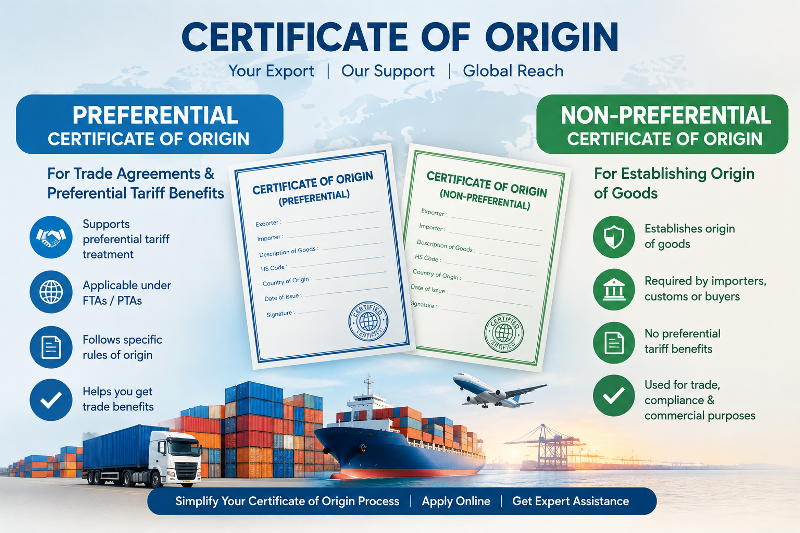
Proof of Value Addition: For Preferential Certificates of Origin (like FTA or GSP), you must prove that your factory added a minimum percentage of value (e.g., 40%) domestically. Therefore, this step often requires detailed costing sheets.
-
Purchase Order / Letter of Credit: Finally, authorities sometimes require these documents to confirm the sale terms between the exporter and importer.
Why Exporters Choose Y.C. Consultation
Compiling the certificate of origin requirements can feel overwhelming. Moreover, ensuring your product’s HS codes match perfectly across all paperwork requires strict attention. Unfortunately, a single typo can halt your entire export process.
At Y.C. Consultation, we carefully review all your certificate of origin documents for export before submission. Specifically, we handle the technical data entry on the eCoO portal. Because of this careful approach, authorities usually approve your application on the very first attempt.
(Note: We provide documentation assistance and consulting; we do not act as the authorized issuing agency itself.)
Therefore, contact our New Delhi office today for expert export documentation support:
-
Mobile / WhatsApp: 9891065895
-
Email: indiaieccode@gmail.com
-
Website: https://ieccode.in

Pingback: Certificate of Origin Fees & Charges in India (2026 Guide)